
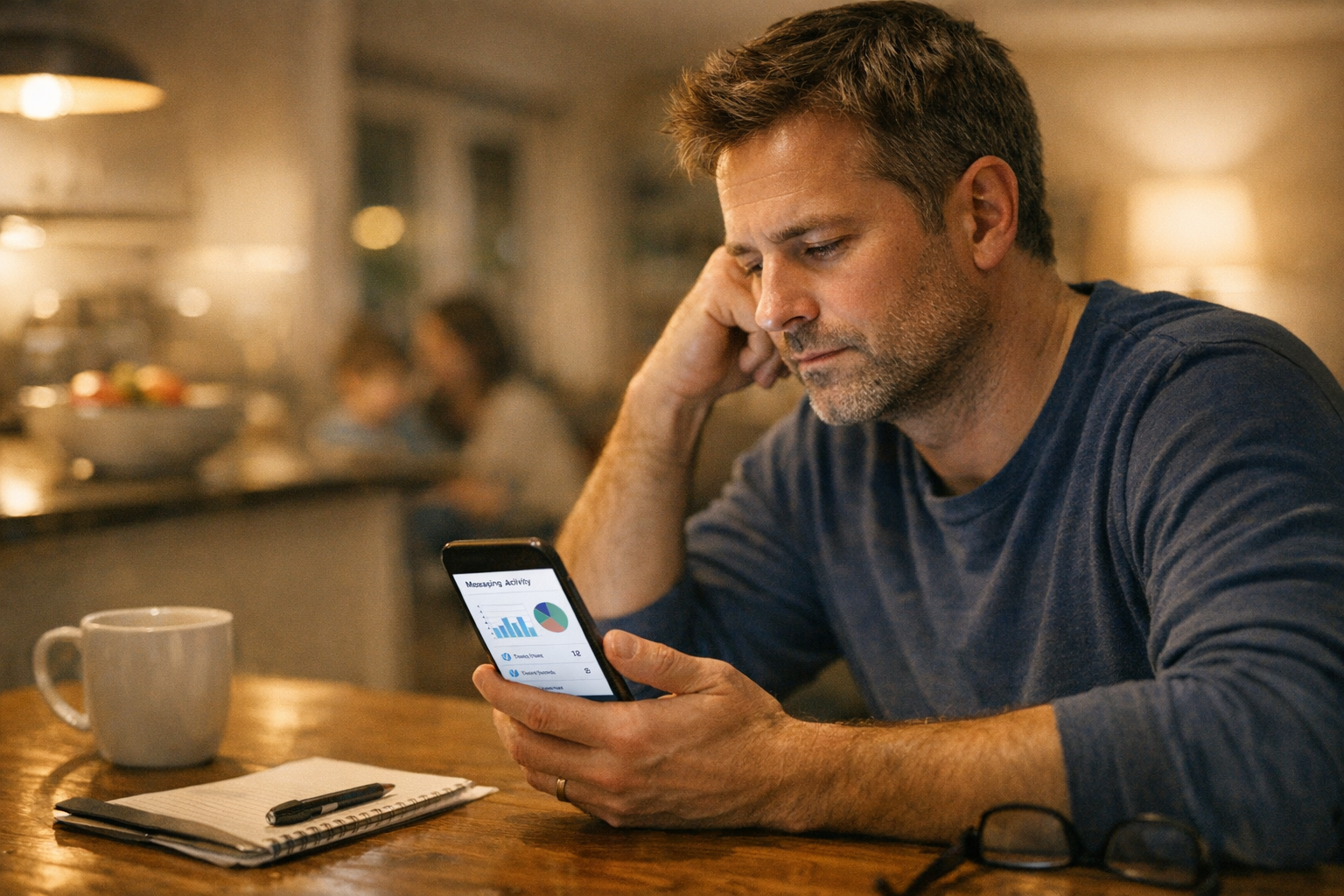
What Luna - Parental Online Tracker Helps You See First
Luna helps organise supported visible online activity on messaging platforms. A timestamp may provide context for an agreed conversation about routines, but it does not prove that someone was awake, studying, distracted or communicating with a particular person.
At its core, Luna focuses on something very simple: giving families a clearer picture of when activity happens on messaging platforms. That matters because messaging use is often fragmented. A person may go online for 2 minutes, disappear, return 10 minutes later, and repeat that pattern across the evening. If you are trying to understand routines, occasional manual checking is not enough. You miss the short sessions, the repeated reconnects, and the broader pattern behind them.
Review visible sessions as a timeline rather than treating an isolated status as a complete account of someone's behaviour. Overlapping online periods do not establish a conversation or its content.
The core problem Luna solves
Most families do not need more notifications. They need context. A child may appear tired in the morning, distracted after school, or unusually secretive with their phone. On their own, those signs are vague. Messaging activity data adds one useful layer of context.
Luna helps answer practical questions such as:
- Is late-night messaging becoming a pattern rather than a one-time exception?
- Are short bursts of online activity interrupting study time?
- Has a routine changed suddenly over the past week?
- Is someone repeatedly going online at hours that do not match healthy device boundaries?
That makes the app less about surveillance for its own sake and more about observation with a purpose. Parents often struggle not because they lack rules, but because they lack evidence of what is actually happening. A direct, direct view of timing patterns can make conversations more grounded and less emotional.
It is also useful for caregivers who are not only thinking about discipline. Sometimes the issue is wellbeing. Irregular overnight activity on telegram app or WhatsApp may signal stress, social pressure, or difficulty disconnecting. You are not diagnosing anything from status logs alone, but you are no longer guessing in the dark.
Who Luna is for
Luna is mainly for parents and guardians who want a clearer understanding of messaging app habits. It is especially relevant in households where online routines have started to affect sleep, school focus, or family boundaries.
Typical users include:
- Parents of teens who want to understand when messaging use spikes, especially at night.
- Co-parents who need a more objective way to discuss device routines and agree on boundaries.
- Guardians of younger phone users who are just beginning to use WhatsApp or Telegram more independently.
- Families with routine concerns where constant online checking has become a source of conflict.
It is not just for households dealing with serious problems. Sometimes parents simply want better visibility before things escalate. If repeated checking of seen status, message activity, or platform logins has already become a habit, a structured tracker is usually more practical than trying to monitor manually.
People looking for similar family-oriented tools sometimes also compare options such as a WhatsApp and Telegram online tracker for family routines to understand which approach fits their needs.
What the first use usually looks like
The first experience with Luna should be simple: choose the account or accounts you want to observe, let the app collect timing data, and then review patterns instead of reacting to isolated moments. The key is to avoid making too much of the first hour or first day. Messaging habits make more sense when viewed across several days.
A practical first-use approach looks like this:
- Start with one clear question. For example: “Is messaging use affecting bedtime?” or “Is study time being interrupted?”
- Track for a few days before drawing conclusions. One active evening does not always mean a trend.
- Focus on timing windows. Late night, early morning, school hours, or homework periods are easier to interpret than raw totals alone.
- Compare patterns with routine expectations. Is the person online during time blocks that were supposed to be device-free?
- Use the findings as a conversation starter. The goal is often better boundaries, not accusation.
This matters because many parents make the same early mistake: they watch individual logins too closely. That tends to increase stress without improving understanding. What helps more is pattern recognition. A repeated 11:45 PM to 1:10 AM activity window tells you much more than one brief login at midnight.
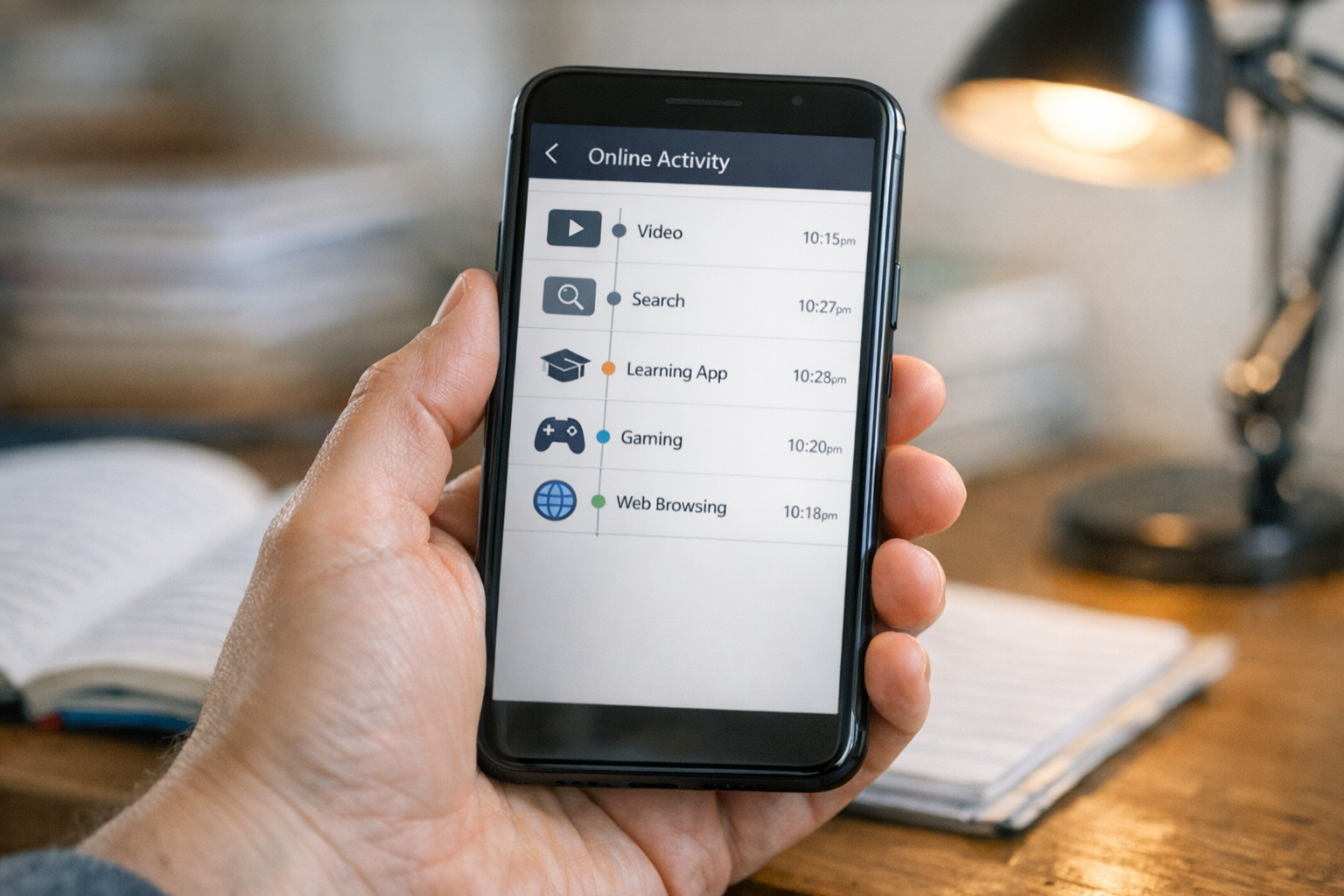
Three practical first-use scenarios
Scenario 1: Checking late-night activity.
A parent notices their teenager is increasingly tired in the morning. The teen says they sleep on time, but school performance is slipping. With Luna, the parent can review whether WhatsApp or Telegram activity continues after bedtime. If repeated late-night last seen changes appear, that gives the family a factual starting point for adjusting device rules.
Scenario 2: Understanding homework-hour interruptions.
A child insists they are studying from 7 PM to 9 PM, yet assignments are taking much longer than expected. Manual checks miss too much because the online sessions are brief. An online status tracking view can reveal whether there are repeated short visits to messaging apps throughout that window.
Scenario 3: Spotting a sudden routine change.
A previously consistent pattern shifts. Someone who usually logs off early begins appearing online much later, or starts showing a new burst of activity before school. That kind of change does not automatically mean trouble, but it may justify a calm conversation. Having a timeline is more useful than relying on instinct alone.
What Luna is not for
It helps to be clear about expectations. Luna is not a replacement for trust, communication, or healthy household rules. It also does not make every online moment meaningful. Some activity is trivial. A quick check-in on telegram, a short status change on whatsapp, or a login via whatsapp web may not matter on its own.
The point is not to overinterpret every signal. The point is to reduce uncertainty when patterns already seem connected to a real-life concern. Used that way, the app is most helpful when paired with reasonable questions and a clear family purpose.
Use the tool within the limits of supported visible data and with the agreement of the people involved. Privacy settings and platform availability can limit visibility; private messages and hidden status are not established by an online timeline.
How to get useful value from the app early
If you are using Luna for the first time, keep the first week focused and realistic. A good first goal is not “track everything.” It is “understand one behavior clearly.”
- Choose one person and one concern to monitor first.
- Look at consistency rather than isolated spikes.
- Review the timing of activity, not just the number of sessions.
- Avoid confronting someone based on a single evening.
- Use the data to support calm discussions about routines.
For families who already use related monitoring or organization tools, it can also help to combine timing visibility with broader household awareness. For example, some parents pair online activity tracking with family location tracking for day-to-day coordination when they want a fuller picture of routines.
Why this kind of visibility matters
Parents are often asked to make decisions about screen time, sleep rules, and messaging boundaries with incomplete information. That is where tension builds. One side feels watched. The other feels ignored or misled. Better visibility does not solve every family disagreement, but it can make the discussion more specific.
Luna exists for that practical middle ground. It gives families a way to observe seen and online timing patterns on messaging platforms without relying on random checks or assumptions. If your main question is not “What was said?” but “When is this person repeatedly online, and is it affecting daily life?” then this type of app makes sense.
Used thoughtfully, the first benefit is clarity. And once you have clarity, the next steps—setting limits, adjusting routines, or simply asking better questions—become much easier.
For the related workflow and its limits, read: How to Find Someone's Location by Phone Number: What Actually Works.